⚠️ Is It Dangerous?
Generally:
- ❌ Not dangerous to humans if touched
- ❌ Not harmful to pets in most cases
- ❌ Usually not a threat to healthy trees
However, you should avoid eating wild fungi unless identified by an expert.
🍽️ Is It Edible?
Some jelly fungi species are edible, but Tremella mesenterica is not commonly eaten due to:
- Minimal flavor
- Confusion with other species
- Identification difficulty
A related species, Tremella fuciformis, is widely used in Asian cuisine and traditional medicine.
🔬 Ecological Importance
This fungus plays an important role:
- Decomposes wood
- Recycles nutrients
- Supports forest ecosystems
- Indicates moisture and biodiversity
It is a normal and healthy sign of a living garden ecosystem.
🧼 Should You Remove It?
Removal is optional.
Remove if:
- You dislike the appearance
- It grows on decorative wood
- You want to slow decay of dead branches
Otherwise, it can be left alone.
Simple removal:
- Wear gloves
- Scrape off gently
- Remove decaying wood if needed
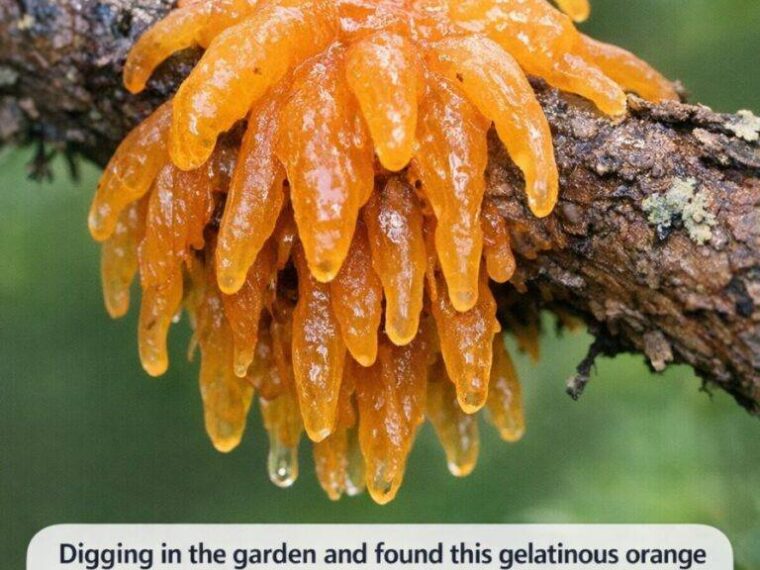
⭐ Why It Looks “Alien”
Its strange appearance comes from:
- Translucent jelly tissue
- Finger-like lobes
- Rapid growth after rain
- Bright unnatural color
Nature often produces forms that look unfamiliar but are completely normal.
✅ Final Thoughts
That orange gelatinous blob is most likely Tremella mesenterica, a harmless jelly fungus sometimes called witch’s butter. While it may look strange, it is a natural decomposer and an important part of your garden’s ecosystem.
Instead of a warning sign, it usually indicates moisture, decaying wood, and healthy biodiversity.