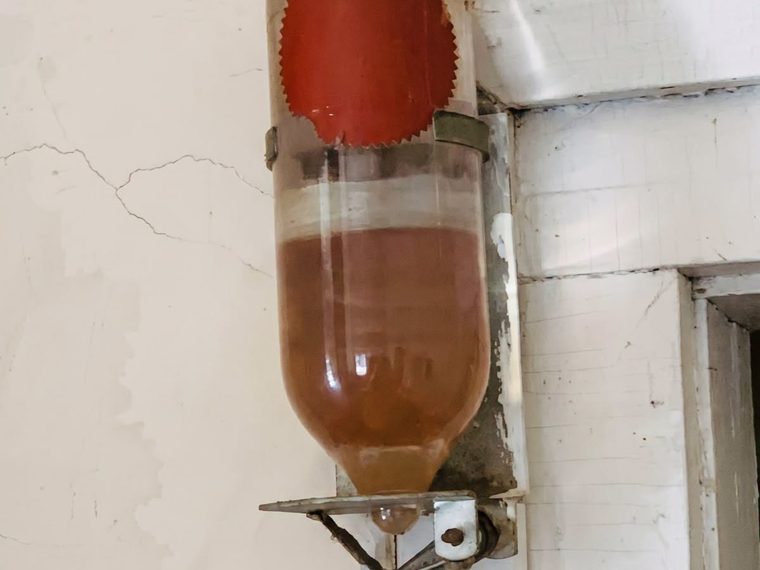
3. How Did an Antique Automatic Fire Extinguisher Work?

Not every antique glass extinguisher worked in the same way. Two main designs became popular.
The Hand-Thrown Fire Grenade
Some extinguishers were designed to be removed from their holders and thrown toward a small fire.
When the glass container broke, its contents spread over the affected area. Depending on the model, the liquid might contain water-based solutions or chemicals intended to help suppress combustion.
These devices were intended for relatively small fires. They were never a reliable substitute for professional firefighting equipment.
The Automatic Wall-Mounted Extinguisher
Other models were designed to activate automatically.
A glass bottle was secured inside a metal bracket fitted with a heat-sensitive mechanism. When the temperature became high enough, a fusible link would melt or release, allowing a spring-loaded hammer to strike the glass.
The liquid would then spill into the surrounding area.
The idea was ingenious for its time. Instead of relying on someone to discover the fire and operate the device, the extinguisher could potentially respond on its own.
However, these mechanisms were not equivalent to modern automatic sprinklers. Their effectiveness depended on the design, the liquid used, the size of the fire, and whether the mechanism operated correctly.
4. Why Were Some of Them So Beautiful?

One of the most fascinating aspects of these antiques is their appearance.
Some historical fire grenades were made from blue, green, or red glass. Others featured ribbed surfaces, embossed lettering, decorative patterns, and distinctive shapes.
Attractive styling helped manufacturers market these products to homeowners who cared about the appearance of their interiors. A colorful glass extinguisher could blend into a room more easily than bulky industrial equipment.
The red glass container in the photograph is particularly striking. Its unusual shape and decorative-looking top make it appear almost like an ornamental bottle.
However, its color alone cannot establish its exact identity or manufacturer.
Today, surviving examples attract collectors interested in antique glass, industrial design, household history, and the development of emergency equipment.
Their beauty tells only part of the story. These objects were created in response to a genuine danger.
5. The Hidden Danger: Not Every Fire Grenade Was Safe

Although these devices were inventive, some historical models contained dangerous chemicals.
Certain older fire grenades used carbon tetrachloride, a chemical once employed in fire-extinguishing equipment. It could suppress some fires, but it was later recognized as hazardous to human health.
Exposure can damage the liver, kidneys, and nervous system. When heated strongly, carbon tetrachloride can also produce highly toxic decomposition products, including phosgene.
These dangers contributed to the withdrawal of carbon-tetrachloride extinguishers from use.
Other limitations included insufficient extinguishing liquid, glass containers that failed to break correctly, and mechanisms that did not activate as intended.
This history reminds us that an invention can be clever and historically significant without being as safe or effective as modern alternatives.
Important safety warning: Never attempt to open, throw, heat, or test an antique fire extinguisher. If you discover one containing an unknown liquid, leave it undisturbed and contact a qualified hazardous-materials professional or local fire-safety authority for advice.
6. From Glass Bottles to Modern Fire Protection

Fire protection has advanced considerably since the era of glass fire grenades.
Modern homes can benefit from several complementary forms of protection.
- Smoke alarms provide an early warning when smoke is detected.
- Modern portable fire extinguishers are designed for particular classes of fire and must be selected and maintained appropriately.
- Automatic sprinkler systems release water when their individual heat-sensitive elements activate.
- Fire-resistant building materials and improved electrical systems can help reduce certain fire risks.
- Emergency escape plans help occupants leave a building quickly and safely.
The underlying principle remains remarkably similar to that of the antique device: detecting a fire early and responding quickly can prevent a small incident from becoming a catastrophe.
The difference is that modern equipment has benefited from advances in engineering, testing, materials science, and an improved understanding of chemical hazards.
7. Could the Object in Your Photograph Be Valuable?

Possibly, but its value would depend on several factors.
Manufacturer and model: Identifiable markings can help establish the object’s origin and historical significance.
Age and rarity: An unusual model or a well-documented early example may attract specialist collectors.
Condition: Cracks, missing components, corrosion, and damage can affect its value. A complete-looking object is not necessarily safe or functional.
Original labels and mechanisms: Surviving labels, patent numbers, and original mounting hardware can help researchers identify the device.
Provenance: Old photographs, receipts, museum records, or information about the building where it was found may provide useful evidence.
To identify the pictured object more precisely, look for manufacturer names, patent numbers, labels, and inscriptions. Do not handle the liquid or dismantle the mechanism. A specialist in antique fire equipment or a museum conservator may be able to identify it from photographs.
It is also important not to assume that every antique glass extinguisher is rare or valuable. Common examples may have modest collector value, while unusual or well-documented models may be more desirable.
Conclusion: An Antique With a Remarkable Secret

The mysterious object in the photograph illustrates how ordinary-looking household objects can conceal extraordinary histories.
What appears to be a decorative glass bottle may actually be an early attempt to solve one of the most frightening problems faced by homeowners: how to stop a fire before it destroys everything.
These devices combined the craftsmanship of decorative glassmaking with the practical ingenuity of early fire-safety engineering. Some relied on human intervention, while others used heat-sensitive mechanisms to break the glass and release the contents automatically.
Their history also offers an important lesson. Innovation does not always produce a perfect solution, and some once-popular technologies are eventually abandoned when their limitations or dangers become clear.
Today, these unusual antiques are valuable reminders of how people tried to protect their homes before modern fire-safety systems became widely available.
The next time you encounter an unusual glass bottle mounted on an old wall, look carefully. It may not be a simple decoration at all—it could be a surviving piece of the history of emergency protection.