
For years, I assumed that washing dishes by hand was the cheaper option. After all, a dishwasher uses electricity, detergent tablets, and water every time it runs. Washing dishes in the sink seemed much simpler: turn on the tap, add a little dish soap, grab a sponge, and clean everything.
But then I started wondering: Was I actually saving money by washing dishes by hand, or was my dishwasher costing less than I thought?
To find out, I decided to try a simple 14-day experiment. Instead of running my dishwasher, I washed every plate, glass, cup, pan, and piece of cutlery by hand. I wanted to compare the water consumption, electricity costs, cleaning supplies, time spent, and overall convenience of both methods.
The results were more interesting than I expected. What seems like the cheaper method at first glance is not necessarily the one that saves the most money.
Here’s what I learned, what the numbers tell us, and how you can decide which method is best for your own household.
1. Why I Decided to Try the 14-Day Experiment
The idea behind this experiment was simple: compare two everyday ways of cleaning dishes and find out which one is more economical.
Dishwashers are often considered convenient but expensive appliances. They consume electricity to heat water, use special detergent, and sometimes require additional products such as rinse aid and dishwasher salt.
Handwashing, on the other hand, appears inexpensive because the supplies are relatively cheap and there is no appliance running in the background.
However, I realized that I had never properly calculated how much hot water I used while washing dishes in the sink.
Every time I left the tap running while rinsing plates, washed several pots, or cleaned greasy pans, I was using more water than I had imagined.
That made me curious about whether the dishwasher might actually be the more economical option.
2. How I Organized the Experiment
To make the comparison meaningful, I used a simple routine for 14 days.
During the experiment, I avoided running the dishwasher and washed all my everyday dishes manually.
I included:
- Dinner plates and breakfast plates.
- Glasses, mugs, and cups.
- Forks, spoons, and knives.
- Cooking pots and pans.
- Mixing bowls and food containers.
- Serving dishes and other kitchen utensils.
I also paid attention to how much hot water I used, how frequently I changed the washing water, how much dishwashing liquid I needed, and how long the entire process took.
The goal was not to claim that every household would get exactly the same results. Instead, I wanted to understand the costs behind each method.
For a fair comparison, it is important to remember that household size, water pressure, dishwasher efficiency, electricity prices, and personal washing habits can all change the final result.
3. The Biggest Surprise: Handwashing Can Use Much More Water
This was one of the most important things I discovered while looking into the numbers.
When you wash dishes by hand, it is easy to underestimate how much water disappears down the drain. A tap running for just a few minutes can use a surprisingly large amount.
The amount depends on how you wash:
- Leaving the tap running while scrubbing uses considerable water.
- Filling a washing-up bowl can reduce consumption.
- Washing several dishes together is usually more efficient than washing each item separately.
- Rinsing every dish under a continuously running tap can quickly increase water use.
A September 2026 comparison by the consumer organization Which? examined 33 recently tested dishwashers and compared their water consumption with an estimate for handwashing.
Here is what it found for 14 place settings:
| Washing method | Estimated water used |
|---|---|
| Handwashing | 63 litres |
| Dishwasher – main program | About 13 litres |
| Dishwasher – eco mode | About 10 litres |
That means the tested dishwashers used approximately 80–84% less water than the handwashing method in this comparison. Which?+1
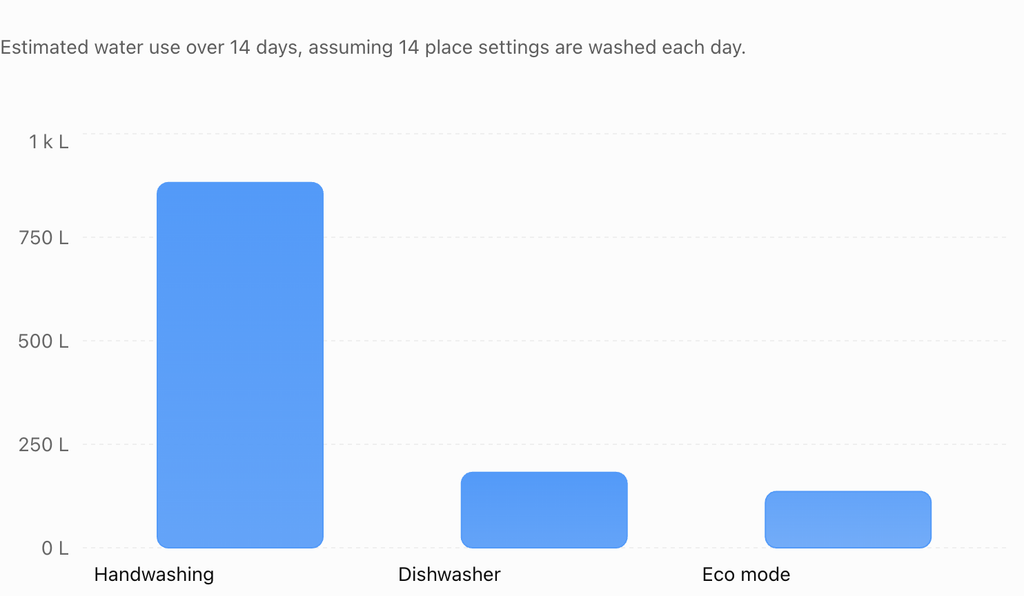
The difference becomes particularly interesting when you imagine repeating the same routine every day.
Illustration: 14 days of washing 14 place settings per day
Based on Which?’s estimated water consumption, not measurements from a personal household experiment.
Estimated water use over 14 days, assuming 14 place settings are washed each day.
0 L250 L500 L750 L1 k LHandwashingDishwasherEco mode
Under these assumptions, eco mode uses approximately 746 litres less water over 14 days than the handwashing comparison.
Of course, this is not a universal result. Someone who washes dishes carefully in a small basin and rinses efficiently may use much less water than someone who leaves the tap running.
But it shows why handwashing is not automatically the cheaper option.
4. What About Electricity? This Is Where Things Get Interesting
TO CONTINUE READING THE ARTICLE PLEASE SEE PAGE 2