Have you ever bought a new pair of jeans, washed them just once, and discovered strange wrinkles, waves, or raised ridges across the fabric? If so, you’re certainly not alone. Many people experience this frustrating problem, especially with modern denim jeans that contain stretch fibers.
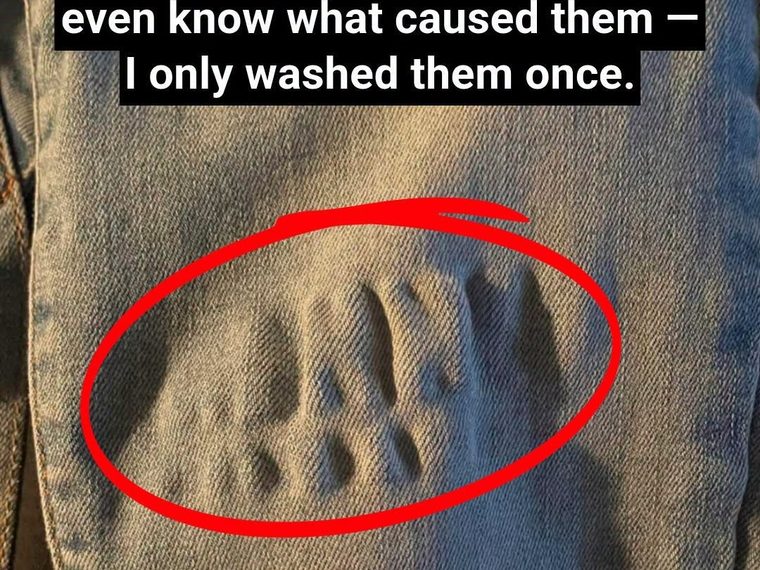
The image above shows an example of unusual ripples in denim. The fabric appears to have developed several raised folds and puckered areas, making the jeans look damaged even though they may have been washed only once.
But what causes these strange marks? Is it a washing machine problem, a manufacturing defect, or simply the way denim reacts to water and heat?
The answer may surprise you. Those ripples can result from uneven fabric shrinkage, tension in the stitching, the composition of the denim, or the way the jeans were dried. And if the same problem appears on two different pairs, it is worth investigating both your laundry routine and the quality of the garments.
Let’s explore the possible causes, how to reduce the ripples, and what you can do to keep your favorite jeans looking smooth for longer.
1. What Are Those Strange Ripples in Denim?

The raised folds visible in the photograph are examples of what textile professionals commonly call fabric puckering or wrinkling. These terms describe areas where the fabric gathers, buckles, or forms uneven waves instead of lying flat.
Not every ripple has the same cause. Some are temporary creases created when wet jeans become twisted in a washing machine. Others are associated with differences in shrinkage between the fabric and the stitching.
There is also a difference between ordinary wear patterns and genuine fabric distortion.
- Temporary wrinkles: These may disappear when the jeans are gently stretched, steamed, or allowed to dry properly.
- Seam puckering: The fabric gathers near stitching, pockets, waistbands, or other reinforced areas.
- Persistent ripples: These remain visible even after the jeans have dried and been smoothed out.
- Wear-related creases: These develop naturally where the fabric repeatedly bends, particularly around the knees, hips, and thighs.
Identifying which type of ripple you have is the first step toward finding the right solution.
2. Uneven Shrinkage: One of the Most Common Causes

One possible explanation is uneven shrinkage.
Traditional denim is primarily made from cotton. When cotton fabric becomes wet, its fibers absorb moisture and swell. During drying, the yarns can relax and the fabric may shrink, depending on how it was manufactured and treated.
The difficulty is that every part of a pair of jeans does not necessarily respond in exactly the same way.
For example, the main fabric panels may shrink differently from areas containing multiple layers of denim, thick seams, pocket linings, and stitching. These differences can create tension across the material.
When one section contracts more than the fabric around it, the surrounding material may buckle or gather, producing the rippled appearance seen in the photograph.
Hot water and high-temperature drying can make this problem worse, particularly when the denim has not been adequately pre-shrunk.
However, even a cold wash cannot guarantee that every pair of jeans will remain perfectly smooth. The fabric’s construction and manufacturing history also matter.
3. Could the Washing Machine Be Responsible?

Your washing machine could be contributing to the problem, even if you have followed your usual laundry routine.
During a wash cycle, denim absorbs water and becomes heavier. The fabric then moves around the drum, folds over itself, and may become twisted or compressed against other garments.
If the jeans remain tightly folded during the spin cycle, some creases can become more pronounced as the fabric dries.
Several washing habits may increase the likelihood of this happening:
- Washing jeans with a very large load of laundry.
- Using an unnecessarily aggressive washing or spinning cycle.
- Washing at a higher temperature than recommended on the care label.
- Leaving wet jeans crumpled in the washing machine for a long time.
- Allowing the jeans to dry while folded or twisted.
These factors do not automatically cause permanent damage, but they can contribute to stubborn wrinkles and distortion.
What should you do instead? Turn your jeans inside out, close the zipper and button, wash them with similar-colored garments, and choose a gentle cycle with cold water when permitted by the care label.
Once the cycle finishes, remove the jeans promptly and smooth the fabric with your hands before hanging them to dry.
4. The Hidden Problem: Stretch Fibers in Modern Jeans

Many modern jeans are not made from 100% cotton. Manufacturers frequently blend cotton with elastane, also known as spandex or Lycra, to make the material more flexible and comfortable.
These stretch fibers help jeans move with your body. They also allow the fabric to recover its shape after sitting, bending, and walking.
However, stretch denim can be sensitive to excessive heat and repeated mechanical stress.
When the elastic fibers deteriorate or lose some of their recovery, the fabric may no longer return to its original shape as effectively. This can produce irregular folds, bagging, or a rippled appearance.
High-temperature tumble drying is particularly worth avoiding when the care label recommends low heat or air drying.
There is an important distinction, though: ripples do not automatically mean that the stretch fibers have been damaged. Similar marks can arise from stitching tension, uneven shrinkage, or temporary creasing.
If the jeans repeatedly return to the same distorted shape after washing and smoothing, the problem may be more persistent than ordinary wrinkles.
5. Sometimes the Problem Starts at the Factory

Here is something many shoppers overlook: the washing machine is not always to blame.
The manufacturing process can also influence how denim behaves after its first wash.
When jeans are produced, the fabric is cut, assembled, stitched, and finished. Several factors can affect the final appearance, including thread tension, fabric tension during sewing, the alignment of the woven material, and the finishing treatments used before the jeans reach the store.
A garment can look perfectly smooth when new but reveal irregularities after moisture and drying allow the material to relax.
This is especially relevant when the ripples appear around:
- Side seams and inner-leg seams.
- Pocket edges and corners.
- The waistband or reinforced sections.
- Areas where several layers of fabric are stitched together.
If the stitching pulls the surrounding denim too tightly, the fabric may gather into small waves.
This is known as seam puckering. It can be a construction or finishing issue rather than a mistake made during washing.
Why would two new pairs develop the same problem?
The photograph’s caption mentions two pairs of jeans with similar ripples after only one wash. That detail is worth considering.
If both pairs came from the same brand, manufacturer, fabric range, or production batch, they might share similar construction or finishing characteristics.
On the other hand, if they were purchased from different manufacturers, the washing routine, drying method, or the properties of the fabrics could be contributing factors.
The photograph alone cannot establish the precise cause, but if the ripples appeared suddenly after the first wash, a manufacturing or fabric-finishing issue is a reasonable possibility.
6. How to Remove Ripples From Jeans You Have Already Washed
TO CONTINUE READING THE ARTICLE PLEASE SEE PAGE 2