🌿 Are Praying Mantises Good for Your Garden?
Absolutely!
Praying mantises are:
✔ Natural pest controllers
✔ Non-venomous and harmless to humans
✔ Beneficial for organic gardening
✔ Predators of flies, mosquitoes, caterpillars, and beetles
They help maintain ecological balance in your backyard.
⚠ Should You Remove It?
Before scraping it off, consider this:
If it’s fall or winter:
- Leave it alone.
- It contains developing eggs.
If it’s spring and already hatched:
- The case will look empty with small exit holes.
- You may remove it if desired.
If it’s in an inconvenient location:
- You can carefully relocate it by cutting the small piece of wood it’s attached to and placing it in a garden shrub.
🔍 How to Tell If It’s Active
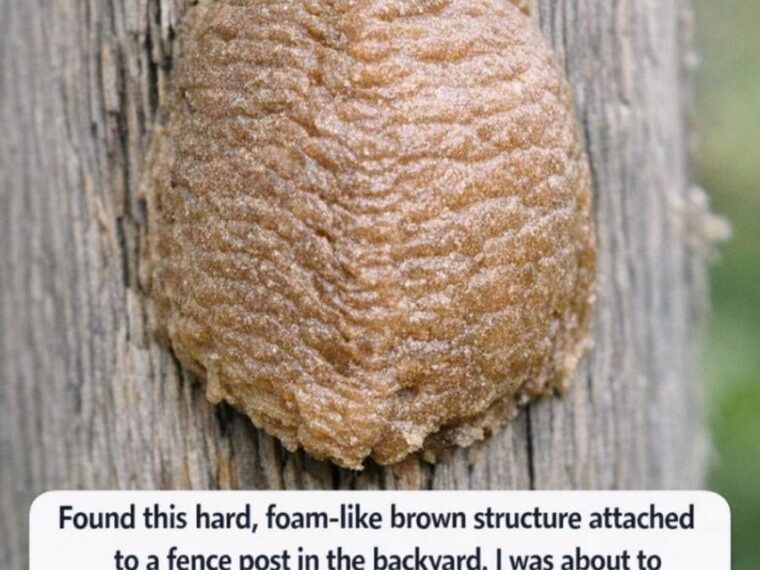
An unhatched egg case:
- Appears sealed and solid
- Has no small holes
- Feels firm
A hatched egg case:
- Has many tiny openings
- Looks slightly collapsed or hollow
🐛 Could It Be Something Else?
While it strongly resembles a mantis ootheca, similar-looking structures could sometimes be:
- Mud dauber wasp nests (made of mud, not foam-like)
- Fungus growth (softer and less structured)
- Expanding insulation foam (usually artificial-looking)
However, the ridged, layered, foamy texture in your image strongly matches a mantis egg case.
🌎 Why This Discovery Is Special
Finding one means:
🌿 Your garden supports biodiversity
🐞 There are beneficial predators nearby
🌱 Your environment is healthy enough for mantises
Many gardeners actually purchase mantis egg cases intentionally to introduce natural pest control.
🏡 Final Thoughts
That strange brown foam-like mass on your fence post isn’t trash — it’s a tiny nursery containing the next generation of garden guardians.
So before scraping it off, remember:
Nature sometimes hides incredible life in the most unexpected forms.